
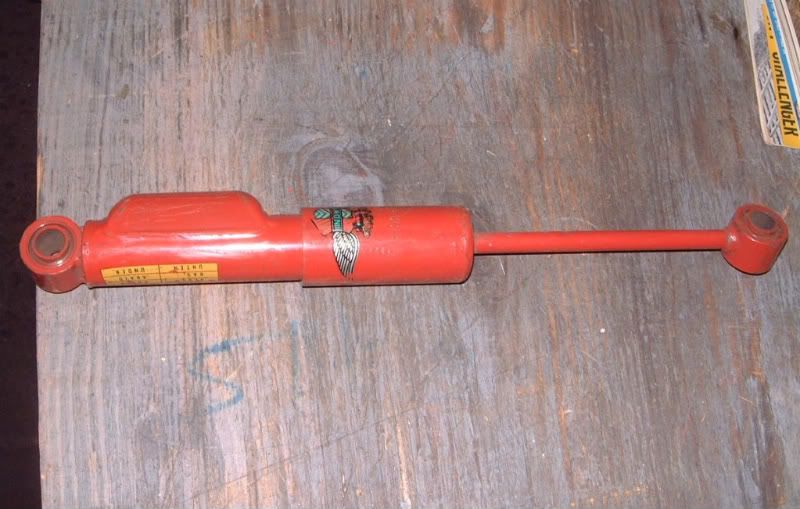
I'm afraid the picture wasn't attached (at least I can't see it). I live in Sweden and the Mustangs delivered here (at least the early ones) got the export brace and the shock upper mounts with the weld on washers. I'll keep my eyes open if I ever see those adjustable shocks. They're the ones with the rings with the small holes, right?
- Welcome to SAAC Forum.
News:
SAAC Member Badges are NOW available. Make your request through https://saac.wildapricot.org to validate membership.
This section allows you to view all posts made by this member. Note that you can only see posts made in areas you currently have access to.
#1
1965 GT350/R-Model / Re: Koni Shock - Special Bolt Question & Washer Question
August 05, 2026, 04:17:32 PM #2
1965 GT350/R-Model / Re: Koni Shock - Special Bolt Question & Washer Question
August 02, 2026, 03:11:39 PMQuote from: J_Speegle on July 14, 2026, 05:06:27 PMFord didn't install Koni's and the shock mounts with the washers were designed for use on export Mustangs like the export brace was. These cars used adjustable Gabriel shocks like the majority of the 66 GT350's.
Do you mean that the adjustable Gabriels were part of the "Export package" (and thus different from the ordinary Handling Package Autolite shocks) on regular (export) Mustangs?
#3
SAAC Forum Discussion Area / Re: 1965 gt350 & K code front coil spring specs?
May 30, 2025, 08:23:28 AMQuote from: TA Coupe on May 29, 2025, 07:48:58 PMThe pound ratings above are absolutely comical. The fronts are approximately triple and the rears are a little more than triple. Realmongo needs to stick his head in a toilet.
Roy
They are load ratings (like you said in your later post). For the coils it was the load it requires to compress them to a certain height representative for ride height (9 inch for a 65-66 IIRC, taller for the different 67+ shock towers). The leaf spring load rating is the load it takes to flatten them.
The large difference between front and rear is that for the front, the leverage of the suspension needs to be taken into account (the spring does not sit on the ball joint but somewhere halfway down the A arm).
For the front: 1413 x 0.6 = 848 x 2 = 1696 pounds
For the front: 650 x 2 = 1300 pounds
Total: 2996 pounds
The spring rate (stiffness) is the extra load it takes to compress the springs another inch.
#4
1966 Shelby GT350/GT350H / Re: Help Identifying KH Brake Calipers
January 13, 2025, 03:05:30 AM
They are Lincoln MkVII rear brakes. Also used on the Mustang SVO and some Saleen models. They were popular for use in disc brake conversion kits in the 90's and early 2000's. I guess they became less popular when these parts became harder to get and custom brake hardware (= not OEM based) became more common.
#5
1965 GT350/R-Model / Re: 5R538
November 16, 2023, 07:41:38 AM
The car later became Charlie Kemp's "World's winningest Shelby", extensively described in Alex Gabbard's "Fast Mustangs" book
#6
1965 GT350/R-Model / Re: Anyone ever seen one of these Konis?.... 2-64 dated, C4ZF-18080 stamped....
September 16, 2023, 07:32:27 AMQuote from: TransamEd on August 02, 2023, 01:49:10 AM
If I remember correctly they had a 1964 Mustang shipped over from UK to Koni/Netherlands, I will need to find again, which one it was.
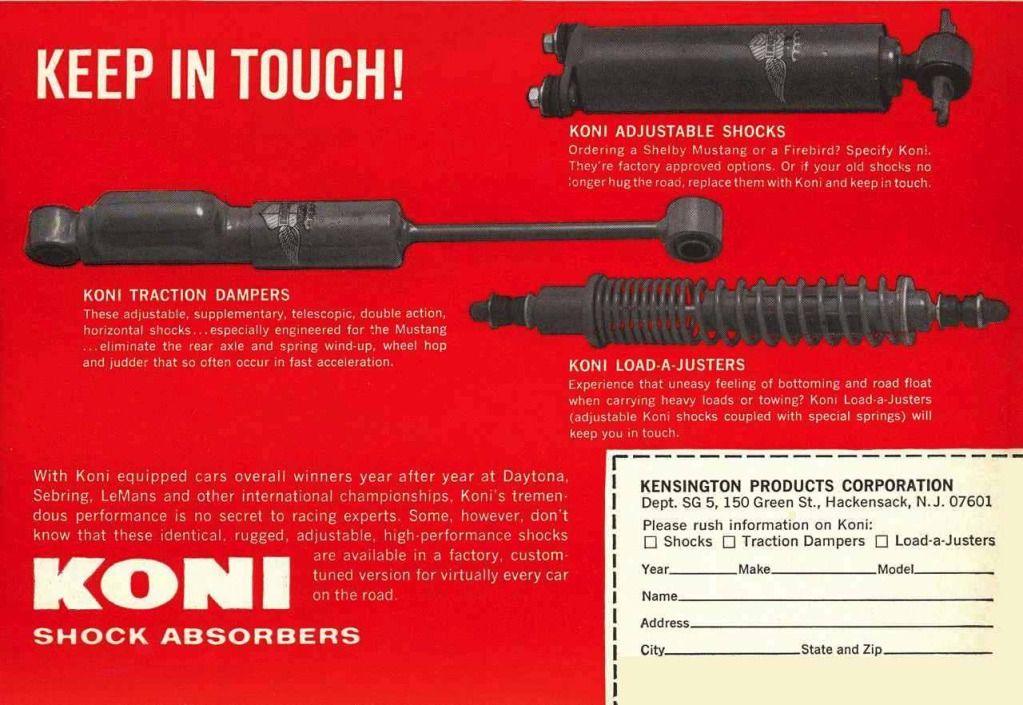
Acc to this article (thanks to Arjan Nugteren/Dutchmustang.nl) Koni developped a variety including a 6 damper upset (2 guide the rear axle better) (Autovisie 30/1965)On sale for 325 dutch guilders.
Interesting info about the rear axle dampers. They're also discussed here: http://www.camaros.org/forum/index.php?topic=7795.15
I thought they were hydraulic replacements for the solid overrider bars but now see in Ed's link that they were intended for below the axle, just like Traction Masters. They would probably not fit anyway in the override position, considering the small slot in the wheel housing they need to fit through.
#7
1965 GT350/R-Model / Re: Anyone ever seen one of these Konis?.... 2-64 dated, C4ZF-18080 stamped....
August 01, 2023, 10:57:19 AM
I realize this thread is kind of old now, but I just noticed these shocks have Oud Beijerland stamped in them, which is the Dutch town where Koni is headquartered. I've never noticed that on Konis before, but I'm no expert on early Konis.
#8
1965 GT350/R-Model / Re: GT 350 Carb?
July 12, 2022, 03:00:09 AM
Speaking of 67 GT350 carbs, did the automatics get the Autolite 4100, like they did in 1966, or did they all get the Holley?
#9
1965 GT350/R-Model / Re: 65 Hipo Engine Balance
March 20, 2022, 03:46:01 PMQuote from: gt350hr on February 24, 2022, 05:43:04 PM
It was to counteract the heavier rods ( big end weight) It was also used on other "non production" engines like the Tunnel Port 302 and Boss 302 T/A engines.
I read that the reason for the hatched was to move some of the counterweight a little more inwards. The increase from 28 oz.inch inbalance to ~30 for the Hipo made the front end counterweight too heavy (too much bending forces) and so a 25 oz.in damper and 5 oz.in hatchet were used instead.
Any truth to that? It sounds logical in one way, but also like a lot of effort for a modest improvement.
#10
1965 GT350/R-Model / Re: 1965 gt350R model Camshaft
March 15, 2022, 07:24:43 AM
One issue with the specs for these old mechanical lifter cams is that you never know how they measured them and what lash they took into account. For the Hipo cam for example, I've seen durations of both 310 and 290 degrees and ~.470" lift (lobe lift x 1.6, probably) and ~.450" lift (actual valve lift)
#11
1965 GT350/R-Model / Re: Another 65 G.T. 350 video recently posted
January 14, 2022, 01:56:40 AMQuote from: FL SAAC on January 09, 2022, 10:08:03 AM
Take aways:
The squid he gave a ride to really enjoyed himself or soiled his pants. I couldn't tell....
Thanks for posting
I doubt he soiled his pants. This is his daily driver: https://www.youtube.com/watch?v=U1HnCeA2ljY
#12
1966 Shelby GT350/GT350H / Re: Quick dissertation on 65/66 Shelbys from Legendary Motorcar
August 17, 2021, 07:51:38 AMQuote from: 2112 on July 25, 2021, 09:36:27 PMQuote from: 427hunter on July 25, 2021, 01:48:02 PM
You can still track your car, they track vintage Ferrari's worth more then twenty times the value of a 65 gt350.
True, but when one of those super valuable F-cars get banged up, does everyone wring their hands and complain that the car no longer has it's "born-with" parts or do they just fix it and move on?
🤔
I sometimes get the impression that for super rare cars, originality becomes less important. With rare cars I mean very low total production of the model.
For special versions of high volume cars, originality of the details is (highly) important, because it's the details that makes it rare. To give a Ford related example: A Mustang K-code coupe is (somewhat) rare, but without the original engine, most of what makes it special is gone and it's just another Mustang. A GT40 on the other hand will always be 1/~100, even after 4 crashes and 10 engine swaps.
#13
1965 GT350/R-Model / Re: Holley 715 CFM #3259 float level adjustment
June 18, 2021, 01:40:48 AM
I have a quick change pot on another carb so I'll probably install that some time and test to find out the best spring. Installing the heavy one was more a matter of let's see what it does.
I agree that the chart is just an approximation with many variables. Or rather, the Holley table is probably accurate for that particular carb on that particular engine and serves as an approximation for other applications.
I agree that the chart is just an approximation with many variables. Or rather, the Holley table is probably accurate for that particular carb on that particular engine and serves as an approximation for other applications.
#14
1965 GT350/R-Model / Re: Holley 715 CFM #3259 float level adjustment
June 16, 2021, 04:28:04 PM
I didn't check it, but it's a regular 289 fuel pump. I did rev it up to max with the sight plugs off to see if fuel level rose abnormally but it stayed were it was so I called it good.
I had a look at Holley's chart for secondary springs which listed the start of opening and fully open engine speeds for a 350 and a 402 with a 3310 (750 cfm) carburetor. The different values scaled almost perfectly with the difference in displacement between the two, so I recalculated them for a 289, also taking into account that secondaries are a little larger and thus flow a little more. The results are in the chart. For the black spring it actually said that it didn't fully open so I had to make a guess here for the "fully open RPM".
As I wrote yesterday, manifold vacuum was just about to creep up (an inch Hg or so) at 6000 RPM with the black spring installed. The theoretical air consumption of a 289 at 6000 RPM is ~500 cfm, which matches the chart almost perfectly. Maybe dumb luck, because I made several assumptions, but still fun to see.
I had a look at Holley's chart for secondary springs which listed the start of opening and fully open engine speeds for a 350 and a 402 with a 3310 (750 cfm) carburetor. The different values scaled almost perfectly with the difference in displacement between the two, so I recalculated them for a 289, also taking into account that secondaries are a little larger and thus flow a little more. The results are in the chart. For the black spring it actually said that it didn't fully open so I had to make a guess here for the "fully open RPM".
As I wrote yesterday, manifold vacuum was just about to creep up (an inch Hg or so) at 6000 RPM with the black spring installed. The theoretical air consumption of a 289 at 6000 RPM is ~500 cfm, which matches the chart almost perfectly. Maybe dumb luck, because I made several assumptions, but still fun to see.
#15
1965 GT350/R-Model / Re: Holley 715 CFM #3259 float level adjustment
June 16, 2021, 01:00:29 AM
Mine are now at the equivalent of .0323 but still a little rich, at least for my engine. On an actual GT350 it may be different.
I wonder why they made those idle feed restrictors so large? I understand that they already did that during the 60's?
Do you know if they increased the secondary idle feed as well?
I wonder why they made those idle feed restrictors so large? I understand that they already did that during the 60's?
Do you know if they increased the secondary idle feed as well?